
The Chrysler Building: New York's Most Beautiful Skyscraper
From the secret steel spire to the century-long observatory saga — this is the building that outclassed them all.

Categories: What to see - Monuments & Attractions
Art Deco Icon | Free Lobby Access | Future Observatory | Best Views in Midtown
Last updated: April 2026

Can You Visit the Chrysler Building?
Yes — partially. The Chrysler Building is primarily a working office building, but its spectacular Art Deco lobby is open to the public free of charge on weekdays.
- What you can do: Walk into the lobby at 405 Lexington Avenue and admire one of the finest interiors in New York. No reservation, no fee, no guided tour required.
- What you cannot do: Access upper floors, the crown, or any part of the building above the lobby. There is no public observatory currently open.
- Lobby hours: Monday through Friday, approximately 8:00 AM to 6:00 PM. Closed weekends and public holidays.
- Guided tours: There are no official building tours offered by the Chrysler Building itself. However, various NYC architecture walking tours include an exterior stop and lobby visit — a guide can bring the details of the building to life in ways that are easy to miss on your own.


The Chrysler Building from NYC's Observatories
Stunning views of Midtown Manhattan reveal the Chrysler Building in all its glory. From the Top of the Rock, the One Vanderbilt Summit, and even the Empire State Building, its iconic stainless-steel crown and Art Deco spire shine against the modern skyline. The metallic brilliance and distinctive crown detail beautifully contrast with contemporary structures.
One day — when the planned observatory on the 61st floor eventually reopens — visitors will be able to admire those legendary eagle gargoyles at eye level from the building itself. Until then, Summit One Vanderbilt offers the closest aerial view of the crown.
What to See – Exterior and Interior
Exterior Highlights
- The white brick and black granite façade, accented with shiny Nirosta (18-8 stainless steel), praised for its durability and aesthetics.
- Elegant tapered spire reaching 1,046 ft (319 m), adorned with automotive-inspired motifs resembling Chrysler hubcaps.
- The famous Art Deco "gargoyles" on the 61st floor — stylized eagle heads echoing Chrysler radiator caps, symbolizing speed and modernity when the building opened in 1930.
Interior Delights – Art Deco Splendor
- The public lobby — crafted from African red marble, Siena travertine, sleek metals, and engraved glass — offers a breathtaking Art Deco experience.
- Chevron-pattern elevator doors and sunburst motifs in Nirosta pay homage to Chrysler automotive design.
- A vaulted ceiling painted by Edward Trumbull (1930), titled "Transport and Human Endeavor," featuring workers, trains, airplanes, and a machine-age hero — spanning 34 by 24 feet.
Lobby access: The lobby is open to the public Monday through Friday, approximately 8:00 AM to 6:00 PM — no ticket required, just walk in. Visitors are welcome to admire the space but should keep visits brief and respectful: this is a working office building, not a museum.
History & Construction: Racing to the Sky
Construction began in January 1929 when architect William Van Alen was commissioned by Walter P. Chrysler to stake a claim in Manhattan's signature skyline. In fierce competition with 40 Wall Street — built by rival architect Craig Severance — Van Alen kept the building's crowning spire secret, assembling it secretly inside the structure and raising it in a single dramatic 90-minute operation on the day of completion. The move gave the Chrysler Building the title of the world's tallest structure.
Completed in just under two years, it held the title of the world's tallest building for 339 days (May 1930 – April 1931), before being surpassed by the Empire State Building.
Art Deco Architecture – Symbolism & Design
The Chrysler's architecture is a visual manifesto of technological progress: radiator-inspired motifs in the spire, turbine-like scrollwork, geometric panels, and bold use of shiny metal. The contrast between brick, stone, and stainless steel celebrates the "machine age" of the late 1920s.
The building's setbacks and inverted pyramid silhouette follow the 1916 Zoning Resolution, yielding an elegant profile and a dynamic skyline presence that has made it one of the most photographed structures in the world.
Trivia & Records
A few numbers tell the Chrysler Building's story better than any superlative:
- It remains the tallest brick building in the world — a record held since 1930.
- Its crown is made of 7,500 triangular stainless-steel panels, each unique in shape.
- It has its own ZIP code: 10174 — shared by only around 40 other buildings in all of Manhattan.
- The building held the world height record for exactly 339 days (May 1930 to April 1931).
- In 2005, a jury of architects, historians, and engineers voted it the most beautiful skyscraper in New York City — nine votes out of ten.
- The original 71st-floor observatory, called the "Celestial," operated from 1930 to 1945, offering views up to 100 miles on clear days — and displayed Walter Chrysler's original mechanic's toolbox as a personal exhibit.
- The steel panels of the crown were tested by an ASTM subcommittee for durability as recently as 1960 — and passed.
- The iconic 1934 photograph by Margaret Bourke-White, taken perched on one of the 61st-floor gargoyles, sold at auction for nearly $96,000.
The Observatory: A Century-Long Story
Few stories in New York real estate are as fascinating — or as unresolved — as the Chrysler Building's observatory.
The Original: The Celestial (1930–1945)
When the building opened in May 1930, it included one of the most spectacular observation spaces of its era: a 1,190-square-foot observatory on the 71st floor called the Celestial, adorned with celestial-themed murals and panoramic windows. On a clear day, visitors could see up to 100 miles. Walter Chrysler even displayed his original mechanic's toolbox here — a nod to his working-class origins before building an automotive empire. The Celestial closed in 1945, as the Empire State Building's observatory drew the city's crowds, and has remained off-limits to the public ever since.
The Plan: A New Observatory on the 61st Floor
In May 2020, the New York City Landmarks Preservation Commission unanimously approved plans by then-owner RFR Realty and design firm Gensler to build a new public observatory on the 61st and 62nd floors — right at the level of the iconic eagle gargoyles. The design called for glass-panel terraces on the north and south sides, open-air platforms, and panoramic views over Midtown that no other observatory in New York could replicate from that angle. Estimated ticket prices were $35–$40.
What Happened: RFR's Collapse and Cooper Union Takes Back Control
Construction never began. RFR's financial difficulties mounted — its Austrian equity partner Signa Holding filed for bankruptcy in 2023 — and by June 2024, RFR had stopped paying the $32 million annual ground rent owed to Cooper Union, the private college that has owned the land beneath the Chrysler Building since 1902.
After RFR accumulated $21 million in unpaid rent, Cooper Union issued a lease termination notice in September 2024. Manhattan Judge Jennifer Schecter confirmed the termination in November 2024. RFR appealed and lost. In January 2025, Aby Rosen's firm was formally evicted from the property.
Cooper Union subsequently appointed Cushman & Wakefield to manage the building and enlisted Savills to market the ground lease to a new long-term operator — effectively putting one of the world's most iconic skyscrapers back on the market.
Where Things Stand in 2026
As of early 2026, Tishman Speyer — the firm that originally developed the building's modern lease structure in the 1990s — is reported to be in advanced talks to become the new leaseholder, according to Crain's New York Business and Bisnow. Savanna is also mentioned as a potential bidder. No deal has been officially confirmed.
The Gensler-designed observatory plan received landmark approval and remains technically valid, but it was RFR's project. Whether the incoming leaseholder will revive it, modify it, or set it aside in favor of other priorities — hotel conversion, office renovation, and a revival of the former Cloud Club are all discussed — remains to be seen.
Bottom line for visitors (2026): The Chrysler Building does not currently have a public observatory. The lobby (free, weekdays only) is the only part of the building accessible to the public. The approved plans for a 61st-floor observatory exist, but construction has not started and no opening date has been announced.
Famous Photos & Film/TV Appearances
The Chrysler Building has appeared in more major Hollywood productions than almost any other New York skyscraper — partly because its distinctive silhouette is instantly recognizable, and partly because it photographs better than almost anything else on the skyline. Its crown frequently appears in aerial establishing shots of New York even when the building itself is not the featured location, making it one of the most-filmed structures in cinema history.
Photography
- Iconic 1934 photograph by Margaret Bourke-White, perched on a gargoyle at the 61st floor — sold at auction for nearly $96,000.
Film Appearances
- Independence Day, Armageddon, Deep Impact, Godzilla, A.I., Spider-Man, Fantastic Four: Rise of the Silver Surfer, The Avengers, Men in Black 3
Television
- Mad Men, The Wiz, Q – The Winged Serpent, The Shadow of the Witness
Film scholar James Sanders once remarked the Chrysler Building "deserves an Oscar for Best Supporting Skyscraper" — a line that captures how reliably it appears in the background of New York's cinematic identity.
The Chrysler Building in Midtown's Urban Fabric
Located in Midtown East, the Chrysler Building harmonizes with architectural landmarks like Grand Central Terminal, the MetLife Building, and Bryant Park. It is often photographed from Lexington Avenue or from the Summit One Vanderbilt observatory, capturing the historical layers of Manhattan in a single frame — the ornate 1930s crown rising above a sea of glass and steel that came decades later.
Visiting Today – Practical Advice
There is no admission fee, no ticket to buy, and no reservation required. The Chrysler Building is one of the most accessible architectural landmarks in New York. Here is what you can actually do on a visit today.
The Lobby: Free and Worth It
The main entrance is at 405 Lexington Avenue at the corner of 42nd Street. Step inside and you are immediately in one of the finest Art Deco interiors in the world. Look up: Edward Trumbull's 1930 mural spans 34 by 24 feet across the vaulted ceiling, depicting workers, trains, aircraft, and the building under construction. The walls are African red marble. The elevator doors are inlaid wood and Nirosta steel in geometric chevron patterns.
- Hours: Monday–Friday, approximately 8:00 AM–6:00 PM
- Weekends and holidays: Closed
- Cost: Free — no ticket required
- Note: This is a working office building. Visitors are welcome but should keep their visit brief and respectful. Security staff are present.
Best Spots to Photograph the Building from Outside
- Lexington Avenue looking north from around 38th Street: the full building rises dramatically with no obstructions — the classic shot.
- 42nd Street at night: the illuminated stainless-steel crown reflects ambient city light and produces extraordinary photographs, especially on overcast evenings.
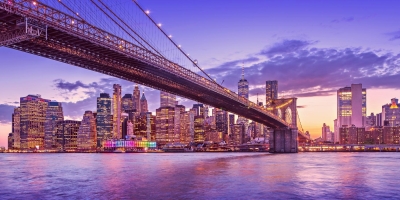
- From the Manhattan Bridge walkway (Brooklyn): the crown appears framed between the bridge's cables and towers — a favorite angle for architectural photographers.
- From the High Line (Chelsea): visible in the distance above the rooftops, offering a west-to-east skyline perspective.
Best Observatories to See the Chrysler Building from Above
Since the Chrysler Building itself has no open observatory, here is where you can find the best aerial views of it:
- Summit One Vanderbilt (One Vanderbilt Ave, 3 blocks away): the closest elevated viewpoint. Nearly side-on view of the crown and eagles. The glass floors and reflective surfaces create surreal perspectives.
- Top of the Rock (30 Rockefeller Plaza, Midtown): the Chrysler appears prominently in the eastern skyline, identifiable immediately by its crown above the surrounding buildings.
- Empire State Building (350 Fifth Ave): clear views eastward toward the Chrysler from both the 86th and 102nd floor observatories.
Getting There
- Subway: Lines 4, 5, 6, 7, and S (shuttle) all stop at Grand Central–42nd Street, a 2-minute walk to the building's entrance on Lexington Avenue.
- From Grand Central Terminal: Exit onto 42nd Street heading east — the Chrysler Building is visible immediately. Its lobby entrance is at the corner of 42nd and Lexington.
- Nearby: Grand Central Terminal (2 min), Bryant Park (7 min on foot), Summit One Vanderbilt (3 min).
Ownership, Preservation & the Future
The Chrysler Building's ownership history is almost as dramatic as its construction — and the latest chapter, unfolding in 2024–2026, is the most significant in decades.
Cooper Union: The Constant Owner
The land beneath the Chrysler Building has belonged to Cooper Union, a private college in Greenwich Village, since 1902 — when industrialist Peter Cooper's family donated it. Cooper Union does not own the building itself; it owns the ground and leases it to whoever operates the skyscraper. This ground lease arrangement, combined with escalating rent obligations, has defined every ownership transition the building has seen.
The RFR Chapter: Ambition and Collapse (2019–2025)
In 2019, real estate developer Aby Rosen's RFR Holding acquired the ground lease for $151 million — a price that shocked the market, as the building had previously been valued at $800 million in 2008. The dramatic discount reflected the burden of Cooper Union's ground rent, which had risen to $32 million annually and was set to escalate to $41 million by 2028.
RFR invested approximately $170 million in renovations and announced ambitious plans: a hotel conversion, a revived Cloud Club restaurant, and the Gensler-designed observatory on the 61st floor, which received Landmarks Preservation Commission approval in May 2020. None of these plans materialized. RFR's Austrian equity partner, Signa Holding, filed for bankruptcy in 2023, and by June 2024 RFR had stopped paying ground rent entirely.
Cooper Union issued a lease termination notice in September 2024. Manhattan Judge Jennifer Schecter confirmed the termination in November 2024. RFR appealed and lost. In January 2025, Rosen's firm was formally evicted from the property.
Cooper Union Takes Back Control (2025)
With RFR removed, Cooper Union assumed full management of the building, appointing Cushman & Wakefield to handle day-to-day operations and Savills to market the ground lease to a new long-term operator. The building was approximately 86% occupied at the time of the transition, with tenants including law firms Moses & Singer and Graubard Miller, and investment firm Saba Capital Management.
What Comes Next: A New Era (2026 and Beyond)
As of early 2026, Tishman Speyer — the firm that first developed the Chrysler Building's modern lease structure in the 1990s and previously held a majority stake — is reported to be the frontrunner to acquire the new ground lease, according to Crain's New York Business and Bisnow. No deal has been officially confirmed.
The Chrysler Building is designated a National Historic Landmark (1976) and an NYC Landmark (1978), protecting both its exterior and its lobby. Any future owner will be required to maintain these protected elements while navigating the substantial cost of the ground rent and the building's need for ongoing infrastructure upgrades.
The approved observatory plan remains on paper. Its future depends entirely on the priorities of the incoming leaseholder.
The Chrysler Building as a Cultural Icon
It stands as a symbol of the optimistic, industrial spirit of the early 1930s — a moment when American ambition expressed itself in gleaming steel and Art Deco ornament. Even in partial access, it remains a must-see for its architectural, historical, and cultural significance. Walking past it on Lexington Avenue, or glimpsing its crown from a taxi on a clear afternoon, is one of those New York moments that never gets old — a centerpiece of any Midtown walking tour and one of the few buildings in the world that genuinely earns the word "beautiful."
Chrysler Building vs. Empire State Building: What's the Difference?
Visitors often ask how the two compare. Here is the honest guide:
| Chrysler Building | Empire State Building | |
|---|---|---|
| Public observatory | No — planned but not yet built | Yes — 86th and 102nd floor, open daily from $48 |
| Lobby access | Free, weekdays only | Lobby free; elevator to observatories requires paid ticket |
| Architectural style | Art Deco — highly ornate, automotive motifs, stainless-steel crown | Art Deco — more austere and monumental in character |
| Height | 1,046 ft (319 m) — 77 floors | 1,454 ft (443 m) with antenna — 102 floors |
| World's tallest | For 339 days in 1930–1931 | From 1931 to 1967 (36 years) |
| Best known for | Its stainless-steel crown and eagle gargoyles — voted most beautiful skyscraper in NYC by expert jury | King Kong (1933); the most recognized skyscraper silhouette in the world |
| Best reason to visit | The free lobby and the exterior — a pure architectural experience at no cost | The panoramic 360° city views from the observation decks, day or night |
Frequently Asked Questions about the Chrysler Building
Can you go inside the Chrysler Building?
Yes — the lobby is open to the public free of charge, Monday through Friday, approximately 8:00 AM to 6:00 PM. No ticket or reservation is required. The lobby is closed on weekends and public holidays. Upper floors and the crown are not accessible to the public.
Is the Chrysler Building observatory open?
No. The Chrysler Building does not currently have an open observatory. A new public sky deck on the 61st floor was approved by the NYC Landmarks Preservation Commission in 2020, but construction never began. As of 2026, the building is undergoing an ownership transition, and the observatory's future depends on who takes over and what they decide to prioritize.
Who owns the Chrysler Building?
Cooper Union, the private New York college, owns the land beneath the building and has since 1902. The building itself is operated through a ground lease. As of early 2026, Cooper Union is marketing the lease through real estate firm Savills, following the court-ordered eviction of previous leaseholder RFR Holding in January 2025. Tishman Speyer is reported to be in advanced talks to take over as the new leaseholder.
What happened to the Chrysler Building observatory plans?
Plans for a new 61st-floor observatory were approved by the NYC Landmarks Preservation Commission in May 2020, designed by Gensler for then-owner RFR Holding. RFR never began construction. In January 2025, RFR was evicted from the building after defaulting on $21 million in unpaid ground rent owed to Cooper Union. The approved plans remain technically valid, but whether the new leaseholder will pursue the project is unknown.
How tall is the Chrysler Building?
The Chrysler Building stands 1,046 feet (319 meters) tall, including its ornamental spire. It has 77 floors. When completed in May 1930, it was the tallest building in the world — a record it held for exactly 339 days, until the Empire State Building surpassed it in April 1931.
What is the Chrysler Building famous for?
The Chrysler Building is famous for its Art Deco architecture — particularly its stainless-steel crown, the seven layered arching terraces at the top, and the iconic eagle gargoyles at the 61st floor. In 2005, a jury of architects and historians voted it the most beautiful skyscraper in New York City. It also held the world height record for 339 days in 1930–1931, and has appeared in dozens of major Hollywood films including The Avengers, Spider-Man, Men in Black 3, and Independence Day.
Can you take photos inside the Chrysler Building?
Photography in the lobby is generally permitted for personal use. There is no official policy against it, but be respectful — this is a working office building entrance, not a tourist attraction. Flash and tripods are not appropriate. The building's exterior can be photographed freely from the street at any time.
How do I get to the Chrysler Building?
The Chrysler Building is at 405 Lexington Avenue at East 42nd Street in Midtown Manhattan. The closest subway is Grand Central–42nd Street, served by the 4, 5, 6, 7, and S lines — a 2-minute walk. Grand Central Terminal itself is directly connected to the station and just steps from the building's entrance on Lexington Avenue.
Is the Chrysler Building included in NYC tourist passes?
There is nothing to purchase for the Chrysler Building — the lobby is free. The building does not currently have a ticketed attraction. If and when the planned 61st-floor observatory opens, it would likely be added to major passes such as the New York CityPASS and the Explorer Pass by Go City.
Map: Where is located and how to get there
Traveling to New York? 3 Articles to learn how to get around the city
Read our Top-3 Articles to learn how to get around New York City using Public Transportation.

Categories: What to know
Categories: What to know
Categories: What to know
ALL TOURS & ACTIVITIES
- Private Walking Tours™
- Private Bespoke Experiences™
- NYC Vacation Packages™
- Corporate & VIP™
- Escorted Coach Tours
- Cruises & Helicopters
- Museum Tickets + NYC Passes
- Broadway Shows
- NYC by Night: Cruises & Activities
- NYC by Holidays: Cruises & Activities
- Restaurants
- Day Trips & Extended Tours
- Guided City Tours
- Bike Tours




.jpg)






 be free!




Unforgettable holiday in New York, fantastic tour operator Irene, who introduced us to the city in all its beauty by telling us the story and describing passionately the life of the place. [...] Irene, I was able to see a Yankees tie as a fan, a dream of mine in the drawer..thanks for your help. Top. Thanks.
From TripAdvisor - May 2025

During my recent trip to New York, I had the pleasure of meeting Irene who accompanied us on a tour of the city, and the experience was unforgettable. From the first moment, she was welcoming, knowledgeable and incredibly passionate [...]
From Google - Feb 2025
We relied on them to organize a group tour in New York. Professional, precise, helpful, friendly. We can only thank Mr. Tony, who followed us impeccably in the planning, and his daughter Irene, an extraordinary guide, who showed us New York in a way that we will not forget. [...]
From Google - November 2024

I am the owner of a Travel Agency. We are Italian in Erba, Eolo travel, I brought a small group and I entrusted myself to Tony. We received great service from start to finish. Punctuality and excellent guides.Thank you for the wonderful experience!!!
From Google - May 2024

Irene? as I have already said elsewhere, she truly deserves all the compliments that are paid to her. Available, friendly, prepared, in short, if you need an Italian speaking guide in New York, she is the right person. You deserve 5 stars and more!
From TripAdvisor - April 2024

An extraordinary experience: I had the pleasure of having Irene as my guide for two days and thanks to the passion she puts into guiding you through the streets of NYC, the anecdotes, the trivia she lets you discover, and the facets she shows during the tour you can't help but fall even more in love with this wonderful city.
From Google - February 2024

Excellent guide, excellent organisation, Irene always ready to respond, available in every topic with competence, you can feel the passion for her work. Her voice accompanied our tour, we will miss you!
From Google - January 2024

[...] unique, very professional, courteous, friendly we can only write positive adjectives, you made us feel at home and have the desire to return. Super recommended. Erica, Marco, Annalisa and Giuseppe.
From Google - December 2023

We did 2 tours together with our guide Irene in one day, Hoboken and the East side. What can I say, in addition to the wonderful places, she has made everything more magical [...]
From Google - January 2023

Irene was a FANTASTIC tour guide! She was so knowledgeable about the area and was so patient with all our questions. We stopped to use the bathroom and we got coffee halfway through, she was so kind! It was a pleasure learning about Brooklyn from you!
From TripAdvisor - April 2022

I’m the biggest fan of Fall activities, but haven’t had a chance to do anything beyond Apple Picking in NJ. I decided to take a last minute 2 day trip with a friend in Hudson Valley, but didn’t know where to start [...] Thankfully I was able to use New York Welcome to do the hard work for us [...]
From TripAdvisor - October 2021
Information about New York
- New York City Travel Guide
- How Much Does New York Cost?
- Christmas in New York
- Best Rooftop Bars in NYC: Where to Drink with a View in New York
- Time Zone and Jet Leg
- Accommodations: Choose Where to Stay
- New York City Public Transportation
- Weather: Fall in New York
- Weather: Winter in New York
- Weather: Spring in New York
- Weather: Summer in New York
- 101+ Excursions in New York City
- Grand Central Terminal
- Covid-19 Updates
Sightseeing & City Tours in NYC
Day Trips from NYC
- Niagara Falls Day Trip by Airplane™
- Washington DC - Visit the Capital
- Niagara Falls & Toronto & 1000-Islands
- American Triangle: 5-Day Excursion
- American Getaway: 4-Day Excursion
- Discover Boston in 1 Day
- 1-Day: The Hamptons & The Beaches
- How to Visit Niagara Falls From NYC
- NYC & Orlando Travel Package™
- NYC & Chicago Travel Package™
- Pre- or Post-Cruise Escapes™
CORPORATE & VIP SERVICES
Our Destinations in The US
Our Company
We are social



 Join our community of over 350K Followers!
Office
 Loading...